Scleral Lenses for Keratoconus & Dry Eye
Custom lenses that vault the cornea and create a gentle, protective fluid layer, helping patients with corneal disease (like keratoconus) and chronic dry eye see and feel better. We fit scleral lenses at our Newton, MA office, serving Needham, Wellesley, Brookline, Waltham, and the Greater Boston area.
Fluid Reservoir Comfort
Bathes the cornea in fluid throughout the day
Sharper Vision
Can neutralize irregular astigmatism from corneal disease
Ocular Surface Protection
Creates a barrier between the cornea and the environment
What Are Scleral Lenses?
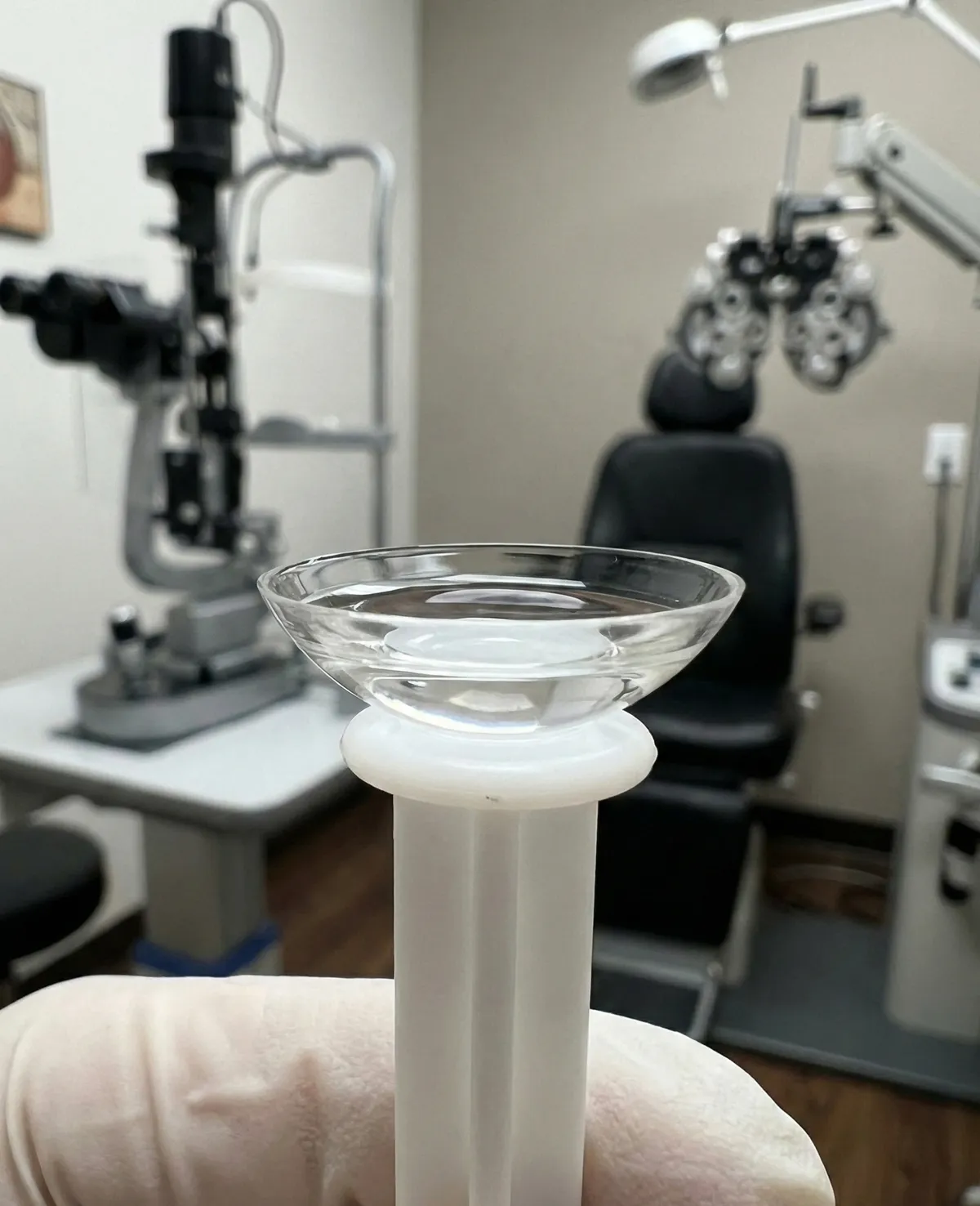
Scleral lenses are large-diameter, gas-permeable specialty contact lenses designed to rest on the white part of the eye (the sclera) rather than on the cornea.
Because they vault over the corneal surface, a scleral lens creates a sealed space that is filled with sterile preservative-free saline at insertion. This “fluid reservoir” can both improve comfort and provide a smooth optical surface for clearer vision.
They’re often used when standard glasses, soft contact lenses, or smaller rigid lenses do not provide enough comfort or vision quality.
Why Patients Love Them
How Scleral Lenses Work
Vault the Cornea
The lens “bridges” over the cornea to avoid direct contact with a sensitive or irregular surface.
Hold a Fluid Reservoir
Sterile saline fills the space underneath, providing continuous lubrication and smoothing the optics.
Improve Vision & Comfort
Many patients experience clearer, more stable vision and better end-of-day comfort.
Who Can Benefit?
We offer scleral lens evaluations for patients who need both comfort and high-quality optics.
Keratoconus & Corneal Irregularity
When the cornea is distorted, vision can fluctuate and glasses may not fully correct it.
Scleral lenses can create a smooth optical surface in front of the cornea, helping neutralize irregular astigmatism and improve clarity for many patients with keratoconus and other corneal irregularities.
Often helpful for:
- ✓ Keratoconus
- ✓ Post-surgical irregular corneas
- ✓ Corneal scarring / surface irregularity
Chronic & Severe Dry Eye
When drops aren’t enough and the ocular surface needs continuous protection.
For some patients, the fluid reservoir under a scleral lens can provide a “bandage” effect, shielding the cornea from wind, friction, and evaporation, often improving comfort and functional vision.
Common reasons we consider sclerals:
- ✓ Severe dry eye symptoms despite lubricants
- ✓ Contact lens intolerance from dryness
- ✓ Ocular surface disease with corneal staining
Note: A comprehensive evaluation is required to confirm candidacy and the safest lens design for your eyes.
Our Scleral Lens Process
Because scleral lenses are fully customized, a careful fit and follow-up are key to comfort, vision, and long-term eye health.
Cornea & Surface Assessment
We evaluate the cornea and ocular surface, review your goals (comfort vs. vision), and confirm whether scleral lenses are the right modality.
Scleral Shape Mapping
We assess the shape of both your cornea and sclera to guide lens design, so the lens lands evenly and comfortably on the eye.
Custom Lens Design
We customize vault (sagittal depth), landing zone alignment, and optics so the lens protects the surface while optimizing vision.
Training & Fine-Tuning
We teach insertion/removal and safe care, then follow up to verify vault/fit and refine the lens parameters as your eyes respond.
Why We Offer Scleral Lenses
Scleral lenses bridge the gap between dry eye therapy and vision rehabilitation. For many patients with keratoconus or chronic dry eye, they can provide a unique combination of improved clarity and day-to-day comfort that’s hard to achieve with drops alone.
They’re especially helpful when:
- ✓Vision is limited by an irregular cornea (even with glasses)
- ✓Dry eye symptoms persist despite optimized drops and therapies
- ✓The ocular surface needs protection from evaporation, wind, and friction
The Technology Behind the Fit
Modern scleral lens systems allow highly adjustable designs so the lens can match your unique eye shape, both the cornea and the sclera.
Lens design is selected based on your eye health, measurements, and goals. An evaluation is required to determine candidacy.
Risks, Side Effects & Safety
Professionally fitted scleral lenses have a strong safety record, and most issues are minor and correctable with a fit or care-routine adjustment. Dr. Patel monitors your eye health at every follow-up, but it's important to know what can come up and what to watch for.
Common & Easily Managed
- Midday fogging: debris or tiny bubbles can cloud the fluid reservoir and blur vision partway through the day. Removing, rinsing, and re-applying the lens clears it, and a fit adjustment often prevents it.
- A learning curve for insertion and removal: sclerals are larger than standard contacts and take practice. We train you with applicator tools at the fitting visit and don't send you home until you're confident.
- Initial lens awareness: mild edge awareness in the first days is normal and fades. Persistent discomfort is a sign the fit needs adjusting, not something to push through.
Rare but Worth Knowing
- Eye infection (microbial keratitis): rare but serious. The risk is minimized with strict hygiene: wash hands, fill the lens only with sterile preservative-free saline (never tap water), and disinfect nightly. Sudden pain, redness, light sensitivity, or blurred vision warrants a same-day call.
- Corneal swelling (hypoxia): the cornea receives less oxygen under a scleral lens and its fluid reservoir. We use high-oxygen lens materials, control the vault of the fit, and set wearing-time guidance to protect corneal health.
- Tight-fit redness: a lens that seals too firmly can leave temporary impression rings or redness where it lands on the white of the eye. This is resolved by adjusting the lens's landing zone.
Scleral lenses are daily-wear lenses: remove and disinfect them nightly, and never sleep in them unless Dr. Patel specifically directs otherwise.
Common Questions
What patients ask most about scleral lenses.
How much do scleral lenses cost?
Cost varies with the complexity of your eyes and the lens design, and insurance coverage differs widely. Some vision and medical plans contribute when scleral lenses are medically necessary, such as for keratoconus or corneal disease. Our Newton office can check your benefits and give you a personalized estimate; call (617) 965-2540.
Are scleral lenses hard to put in and take out?
There's a learning curve because the lens is filled with saline and applied face-down, but nearly everyone masters it with practice. We provide hands-on training and applicator tools at your fitting visit, and most patients are fully comfortable with the routine within days to a few weeks.
Can I sleep or nap in scleral lenses?
No. Scleral lenses are daily-wear lenses: the fluid reservoir isn't refreshed while your eyes are closed, and sleeping in them raises the risk of corneal swelling and infection. Remove and disinfect them every night unless Dr. Patel gives you specific instructions otherwise.
How long does a pair of scleral lenses last?
Most scleral lenses are replaced every one to three years, depending on how the lens surface holds up to deposits and whether your eyes or prescription change. Regular follow-up visits let us track the lens condition and your corneal health, so replacement happens on your eyes' schedule rather than a fixed calendar.
Related Treatments
Dry Eye Assessment
Comprehensive diagnostic testing to identify the root causes of your symptoms.
NuLids PRO Therapy
Gentle eyelid exfoliation and stimulation for blepharitis and MGD relief.
Punctal Plugs
Reversible tear duct inserts that help your eyes retain natural moisture.
IPL Treatment in Newton (OptiLight)
FDA-approved light therapy targeting inflammation and restoring meibomian gland function.
Ready to Explore Scleral Lenses?
Schedule an evaluation to see whether scleral lenses are a good fit for your eyes, your comfort, and your vision goals.